
More Than 60 Ontario Groups Call For Protection From Lawsuits Designed to Muzzle
Demand grows for law to protect public participation in wake of recent suit against health advocates
 Toronto – More than 60 Ontario groups released a letter to Premier McGuinty today asking him to move forward with a new law to protect citizens from lawsuits designed to stifle legitimate public participation in the democratic process. Such suits are often called strategic lawsuits against public participation, or SLAPPs.
"Many of us in the environmental movement have suffered when public participation in the democratic process was threatened," said Gideon Forman, Executive Director of Canadian Association of Physicians for the Environment (CAPE). "So we support anti-SLAPP legislation based on our first-hand experience."
Environmental Defence initiated the letter and had experience with a SLAPP itself when a partner group it works with was sued for opposing a development at Big Bay Point on Lake Simcoe.
"It's courageous enough for citizens and small organizations to stand up for what they think is right," said Dr. Rick Smith, Executive Director of Environmental Defence, "But to be sued for participating in what is supposed to be a democracy? That's scary."
Many of the 60 signatories to the letter have experience with a SLAPP, which can put victims in the position of either backing down or losing everything. The letter to Premier McGuinty concludes that legislation is the best measure to protect Ontarians' rights: "As a community of organizations, we feel our democratic rights are threatened by the existence of SLAPP suits and insist that the only way to protect our right to public participation is through the creation of effective legislation."
Ontario would be joining Quebec, where similar legislation passed last year, and over half of American states that currently have anti-SLAPP laws.
Support for creating such laws has snowballed in recent months, notably with the release of the Environmental Commissioner of Ontario's Annual Report in October. Commissioner Gord Miller labeled SLAPPs a threat to public participation and called on the government to create effective laws to prevent them.
Shortly after, the Association of Municipalities of Ontario resolved to meet with the Ontario government to find solutions to prevent SLAPPs and to avoid undue costs placed on citizens in Ontario Municipal Board hearings. The Association acted after 62 municipalities, including Mississauga and Hamilton, passed resolutions calling for anti-SLAPP legislation, and requested the Association support them.
-30-
For more information, or to arrange interviews, please contact: Jennifer Foulds, Environmental Defence, (416) 323-9521 ext. 232; (647) 280-9521 (cell)
Environmental Defence: http://environmentaldefence.ca/pressroom/viewnews.php?id=738
Town Approves Tree Cutting at Big Bay Point
Environmental Defence (www.environmentaldefence.ca)
Developer proceeding despite objection from Province and concerned residents
Toronto – The developer of the proposed Big Bay Point Mega-Marina is preparing to cut trees at the site despite opposition from the province and local citizens. Heavy machinery moved onto the site yesterday. Tree cutting is expected to begin soon, unless the province intervenes as requested by Environmental Defence and the Innisfil District Association (“IDA”).
Innisfil Council voted on January 27 to allow site alteration in the form of tree cutting at Big Bay Point. The vote appears to defy directions from the Ministry of Municipal Affairs and Housing (“MMAH”), which has jurisdiction over Ontario municipalities.
The province sent a sharply worded letter on January 19, 2010 to the developer’s lawyers last week, advising that “provincial staff have identified provisions that must be satisfied before site alteration or development of the Big Bay Point resort lands can take place.”
Put plainly, the MMAH letter stated that the Big Bay Point project, including any tree cutting, cannot proceed until an environmental assessment has been completed to determine whether there will be sufficient capacity to collect and treat wastewater from the mega-marina. The environmental assessment would also need to show that the mega-marina would not directly or indirectly release phosphorus into Lake Simcoe.
The Ontario Municipal Board made clear in its 2007 ruling on Big Bay Point that that the Planning Act approval is conditional on the developer securing a large number of environmental approvals, some of which may never be obtained, for the construction of the 2,000 resort units, 1,000 slip mega-marina and commercial space.
Environmental Defence and the IDA have filed a legal brief with the Lake Simcoe Region Conservation Authority and the province last week advising that the proposed excavation of 30 acres of shoreline likely contravenes the Lake Simcoe Protection Act and Conservation Authorities Act.
“The Big Bay Point Mega-Marina and unprecedented shoreline excavation would never be permitted if it were proposed today and may never be approved, so why the rush to cut the trees?” asked Environmental Defence counsel David Donnelly, citing the ban on new shoreline development under the Lake Simcoe Protection Plan. “So if the project never proceeds, as we predict, why would anybody think it wise to cut increasingly rare shoreline forested area at this time”, Donnelly asked.
“Speaking as an area resident, I’m appalled that Innisfil Council is endorsing this tree cutting before the province has even approved any marina construction”, said Don Avery, past President of the IDA.
This new dispute follows closely on a complaint lodged with the Minister of Environment John Gerretsen for proceeding with public consultations under the Lake Simcoe Protection Act and Environmental Assessment with tens of millions of dollars in Strategic Lawsuits Against Public Participation (“SLAPP”) suits outstanding against Big Bay Point opponents. The complaint states that:
Continuing these taxpayer funded public consultations in this climate of SLAPP suits is unacceptable. We note that this phenomenon has proliferated under your government. We call your attention to the Ministry of the Environment Statement of Environmental Values, specifically the Introduction which advises [that] “Ontarians should have the means to ensure that it is achieved in an effective, timely, open and fair manner.”
It is hard to believe a decision-maker or Tribunal would find that approval of the infrastructure under the EA process, conducted under the pall of millions of dollars of SLAPP suits could be considered an “open and fair process”. Most of the province’s environmental organizations have called on the McGuinty government to put an end to SLAPPs and on-going public consultation processes tainted by them.
Background
The Big Bay Point proposal would feature 2,000 hotel and condominium units, retail space, a 300-seat theatre and an unprecedented 1,000-slip mega-marina. Constructing this marina would require digging a 30-acre hole in the shoreline and destroying 100 acres of forest. There is an existing, much smaller marina on the property. The endangered butternut tree is also found on the property.
Strategic Lawsuits Against Public Participation (SLAPPs) are lawsuits (often for defamation) that are aimed at dissuading citizens from making their voices heard before public decision-makers and tribunals. They are a growing threat to meaningful citizen participation in Ontario and constitute a significant barrier to access to justice for those members of the public who seek to participate in environmental law and policy matters. Members of the IDA are currently the targets of SLAPPs seeking millions of dollars in damages over their opposition to Big Bay Point.
-30-
For more information, or to arrange interviews, please contact: Erin Charter, Environmental Defence, (416) 323-9521 ext. 258; (647) 210-7888(cell) David Donnelly, Donnelly Law, (416)-722-0220 (cell) Don Avery, Innisfil District Association, 416-997-7836 (cell)
A green solution to a neighbour's spat
Oysterman Rodney Clark and developer Hans Jain find an environmentally friendly way to settle what could have been a nasty legal battle
Dave LeBlanc - Globe and Mail
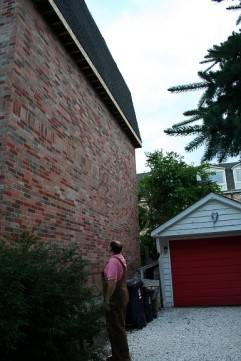
We've all heard of a "golden handshake." Now, thanks to environmental lawyer David Donnelly, Toronto has just witnessed its first green handshake, which may set a precedent for homeowners in older neighbourhoods facing the pressures of infill development.
Shaking hands are self-described "urban oysterman" Rodney Clark, a 17-year resident of east-end Kimberley Ave. and owner of Rodney's Oyster House on King St. West, and developer Hans Jain of Atria Development Corporation.
At issue is Mr. Jain's eight-unit townhouse development, near Main and Gerrard
Streets. While seven of the units quietly snake behind the backyard fence of Mr. Clark's handsome century home, the sole detached unit comes within inches of Mr. Clark's quahog shell-covered driveway, and its tall, blank wall substitutes a good deal of his blue-sky view with unwanted shadows.
"He was shouting into the phone that he had just woken up to the sight of the Trump Tower screening out his sunlight," remembers Mr. Donnelly about the phone call he received from Mr. Clark, who had just come home from a lengthy business trip. "He likes to tell a good story so I thought he was either pulling my leg or he'd switched up his medication."
Since Mr. Clark was an old friend - the two know each other through mutual participation in the Ontario Oyster Festival and its support of the advocacy group Environmental Defence - Mr. Donnelly drove over and had a look. While Mr. Donnelly was aware that Atria had purchased the lot with development approvals already in place and, further, that Mr. Clark and his neighbours had fought the previous developer to reduce the scale and impact of the infill project, he was still "quite surprised" at the size of the one detached house: "It really does dominate that part of the street and certainly overshadows a good part of Rodney's property."
So, after calming Mr. Clark down, he arranged a meeting with Mr. Jain. His expectations for a resolution were high, since he'd had past dealings with the Jain family and found them to be "first-class developers." However, since Ontario does not have "right to light" legislation, which exists in some American states and the United Kingdom, he knew his friend would be "out of luck in terms of the traditional planning tools to force some kind of compliance on Mr. Jain."
In other words, the three men would have to find a more creative solution.
Mr. Clark did have a small bargaining chip. In order to finish masonry and roofing work, Mr. Jain would need to rent Mr. Clark's driveway to erect scaffolding. But, instead of a simple cash payout, Mr. Donnelly suggested that Atria install a solar-thermal unit on Mr. Clark's roof so he could "capture what's left of his sunlight and turn it into green energy," says the lawyer. That way, "every time Rodney takes a shower or does his dishes he can think, 'You know, there's something positive that has come out of this experience about being impacted by infill development.' "
"It's not as bad as lobster fishermen getting a poor catch and getting a subsidy from the Minister of Fisheries," adds Mr. Clark, "and it's not that everyone should be at the front door receiving a cheque - it's that [Atria is] changing the design of the community, therefore they have to put something back into it."
Mr. Jain agrees: "We have to work with our neighbours, and [Mr. Clark] seemed like a reasonable guy; we could have had a long and protracted discourse with lawyers and all of that on a really adversarial basis but, I think, on both our sides it doesn't pay."
In addition to the solar panel, Mr. Jain agreed to hire a local landscape architect to soften the tall, blank wall with plantings. And he's decided to incorporate more sustainable features into future projects: "You want to do better for your children," he says, simply.
After the green handshake, Mr. Donnelly drew up a formal contract, which he hopes will serve as a model for future homeowners in similar situations. Until, that is, the province passes its own right-to-light legislation: "It's the next big battleground on the road to Ontario's sustainable energy future."
It is legislation Mr. Donnelly would be happy to help prepare in order to protect both the homeowner and their sunlight but also allow people to develop more intensively in urban areas. "We have [older and underutilized] two-storey buildings along a subway line, so we have a long way to go," he says. "The [city's official] target is a half-million people in downtown Toronto, in my opinion it should be a million or more and there's only one way to go and that's up."
And, just like an oyster covering an unwanted irritant to form a pearl, so too has Mr. Clark turned what could have been an irritating real estate situation into something much more palatable: "There has to be in the community stewardship, sustainability and some realization that we all have to fish off the same wharf."
***
Globe and Mail: http://www.theglobeandmail.com/real-estate/a-green-solution-to-a-neighbours-spat/article1213370/
Critics slam province for rezoning farmland
Phinjo Gombu urban affairs reporter - Toronto Star
 The province has caved in to developers – and short-term worries about jobs – and disregarded its long-term war on sprawl, by allowing prime farmland just north of the Greenbelt to be turned over to industry, environmentalists and residents say.
The Municipal Affairs ministry's intention to change the zoning of more than 500 hectares near Highways 400 and 88, between Bond Head and the urban area of Bradford West Gwillimbury, will allow Toromont Industries to transfer its Vaughan operations to a 40-hectare site there.
The Star first reported in March that Toromont, an assembler and distributor of large industrial equipment, had threatened to move to Manitoba – putting hundreds, if not thousands, of jobs at risk – if it wasn't permitted to build on that site.
The province's settlement document shows how the cost of allocating 40 hectares to Toromont and servicing that area with water and sewer pipes could only be justified with more development.
The move is the thin edge of the wedge, says David Donnelly, a lawyer for Environmental Defence.
The decision violates the province's Places to Grow plan, invites further sprawl in an area that has no public transit and will promote more highway congestion, Donnelly said yesterday.
Places to Grow, a sweeping, long-range attempt to manage growth across southern Ontario, prescribes intensified development in particular areas to limit sprawl. The much-heralded plan has earned the prestigious Daniel Burnham planning award from the American Planning Association.
The provincial rezoning orders "are inexplicable and effectively cut the province's award-winning Places to Grow legislation to ribbons," said Donnelly. He described the plan as a prime example of tic-tac-toe development that, as feared, has begun to "leapfrog" over the protected Greenbelt area.
Jeffrey Davies, a lawyer for the developers, Geranium and Metrus Developments, called that characterization unfortunate.
"We are at a time in our economy where there is a desperate need for jobs, and we have no other similarly large tracts of land for large-scale industries available in southern Ontario," Davies said. "It is anything but caving in. To the contrary, this is good, sound, responsible planning."
Local dairy farmer Robert Keffler, representing the group Bond Head Bradford West Gwillimbury Residents for Responsible Development, said the urbanization being welcomed by local politicians as a "lifeline to the future" threatens nearby agricultural land.
"We are in a good farming area," said Keffler. "We think it's decidedly not good environmental or agricultural planning to build a new industrial node beside a flood plain that drains into the Holland Marsh, Ontario's salad bowl."
Documents show that secret negotiations among the province, developers and local municipalities were prompted by Toromont's decision to move its head office, training, and manufacturing and distribution operations to the area.
The company is being forced out of the path of Toronto's subway as it is expanded. It has denied that any more than 500 jobs were ever in play, or that it threatened to move out of the province.
Senior officials in the ministries of municipal affairs and infrastructure had questioned enthusiasm for new employment nodes on Highway 400, saying there was an "oversupply" of designated employment lands in south Simcoe County. They had expected to challenge the project at the Ontario Municipal Board, but a high-level decision to enter into negotiations put an abrupt end to that plan.
The province has also agreed to allow a tenfold expansion of the nearby hamlet of Bond Head – increasing its population to 4,500 from 500 – on about 210 hectares. It would be serviced on the same utility lines as the employment zone.
The agreement needs OMB approval, and future development is subject to an environmental assessment process, as well as the Lake Simcoe Protection Act.
There's further pressure for sprawl north along Highway 400, with the Town of Innisfil pushing for an employment zone on its own strip of agricultural land. The province is already challenging parts of that plan before the Ontario Municipal Board – as it had planned to do in the Bradford West Gwillimbury area before deciding to negotiate over the Toromont deal.
Existing land zoned for employment within the Bradford West Gwillimbury urban limits will now be "frozen" and come into play only if a bypass connecting Highway 400 and Highway 404 is built. The province's current growth plan does not contemplate such a bypass.
Ontario is trying to cap the number of homes built in south Simcoe over the next 25 years. The limit is close to half what developers want.
***
Toronto Star: http://www.thestar.com/news/gta/article/634129
Sowing green seeds on council
Fundraising network aims to help aspiring city politicians with eco-focused platforms
Tess Kalinowski
STAFF REPORTER - Toronto Star

"Big heart, big brain, big soul – all green."
That's how Toronto City Councillor Paula Fletcher describes lawyer, urban planner and activist David Donnelly, who also happens to live in her Riverdale ward.
Battle plans for many of the environmental skirmishes being fought in communities that shoulder Toronto are drawn on Donnelly's downtown desk. Think Big Pipe, the Oak Ridges Moraine, Boyd Park, Bayview Extension and Big Bay Point Resort.
His small army of allies is growing, thanks in part to the platform and fundraising network created before the 2006 municipal election by Donnelly, first-term Pickering councillor Bonnie Littley, Liberal insider Judy Pfeifer and Richmond Hill naturalist Natalie Helferty.
They dubbed it Green Divas for Council.
The idea was to give a helping hand to environmental candidates willing to take on the developers at municipal councils.
"There's an incredible wealth of very committed, passionate, professional, sophisticated people who are shut out of the (political) process because no one will open the door or give them resources," says Donnelly, 44.
"Municipal politics and federal politics is an elite club, and it's closed to a great extent. ... Even though there is
incredible support and sympathy amongst the voters for independent, environmentally minded candidates, no club exists to help with the fundraising, give them some policy ideas for their platform, and they're not united."
The Divas' Green Agenda, with an introductory letter signed by singer-activist and Donnelly client Sarah Harmer, says a Divas candidate:
- Will not accept contributions from developers;
- Will not shrink the Greenbelt;
- Will promote green building standards.
Donnelly's green heroes aren't all women.
He lists Oakville Mayor Rob Burton among the "divos" and says there are bright spots on the regional landscape, thanks to the work of that council and others, such as those of Ajax and Markham, which are also making progress.
***
Toronto Star: http://www.thestar.com/specialsections/article/577745