
Anishnawbe Health Toronto gets $1.5 million grant
The Toronto aboriginal health-care group that forfeited a prized downtown site for a new clinic over concerns the land may be a Roman Catholic graveyard is now one step closer to building its dream facility.
Anishnawbe Health Toronto received approval Tuesday for a $1,485,000 provincial planning and design grant to consolidate its three GTA clinics into a single, iconic aboriginal structure.
The funds came from the Ministry of Health and Long-Term Care.
“We look forward to creating a legacy for our people,’’ said AHT’s executive director, Joe Hester, who’s desperate to replace two cramped clinics off Sherbourne St. and another on Vaughan Rd. with a facility where traditional healing and modern medicine will be practised in tandem.
“For us, it will have to be a home, and home has to be a place of beauty. Home has to be inviting. It’s a place for rest, respite, and it represents you as a person.”
Once a new downtown site has been selected — negotiations for locations are underway — and design bids have been tendered, it’s expected construction capital will be quickly forthcoming from the province.
The project will get input from aboriginal elders before a final design bid is chosen.
Hester said the grant announcement, made at AHT’s clinic across from the Moss Park Arena, was one of the few bright moments in a decade-long quest to better serve the 85,000 aboriginal men, women and children living in the GTA. It’s a group whose overall health is two to three times lower than that of the general Canadian population.
“It’s been like a long battle and now, we’re starting to realize victory,” said Hester.
“It’s really important for us as a people to be able to move forward with our agendas in terms of our needs.”
One of those needs is beauty. So the clinic won’t be another grey bunker amid the downtown condos. Think more Douglas Cardinal: flowing, welcoming, hugging nature.
“It’s not just (going to be) a health-care centre, it’s a place of refuge for our people,” said Jacques Huot, president of AHT’s board of directors, noting that spiritual wellness is a component of caring for physical ailments in native culture.
“Toronto can be an incredibly intimidating place for someone who has just left the reserve, who has left the beauty of Mother Nature and comes into this concrete jungle. So architectural beauty, if you want to call it that, is an important part of the healing process. (A building) is not just a functional thing, it’s an emotional thing as well.”
Cardinal had been approached previously by AHT about creating a one-of-a-kind aboriginal structure the city could enjoy as art.
The internationally renowned architect and Officer of the Order of Canada, who is of Métis and Blackfoot heritage, said working with “grassroots” people like AHT enables him to meld beauty and community service — a pairing he believes is too rare in society.
“Why shouldn’t these programs — and most programs that serve the public — be beautiful?” Cardinal said in a recent interview.
“This is an opportunity to create something that follows the values of the First Nations — creating beauty and harmony, which is an intrinsic part of their culture . . . There’s so much ugliness which adds to our social problems in our built environment, so if the First Nations want to do something about providing beauty and share that with the rest of the community, I think that’s a wonderful vision.”
In July, AHT was considering building at 51 Power St.. The group hired an architectural firm to draw preliminary sketches of a turtle-shaped, three-storey clinic with a sweat lodge.
But a phone call from Toronto Councillor Pam McConnell’s office warned AHT executives that the grassy wedge, located south of the Don Valley Parkway’s Richmond St. off ramp, near Parliament St., might contain human remains.
The lot is just metres southwest of St. Paul’s enormous 19th century cemetery, where about 3,000 people — possibly more — were interred, a third of them Irish typhus victims in 1847. One city official said old maps indicate the cemetery by the basilica was never fenced off, so the true graveyard boundaries are unknown.
Today, the area is an official City of Toronto off-leash dog park called Orphans Greenspace, where pets can relieve themselves.
The decision to leave human bones — and, more important, the souls of the dead — undisturbed is in keeping with native beliefs.
“That door closed on us and represented a bit of a fallback, but we had the determination to continue,” Hester said of walking away from the Power St. plot.
“But at the same time, it wasn’t a hard decision for us. It was the right decision, so we felt good about that. It was a mixed blessing.”
AHT is an accredited community health centre funded through the Toronto Central Local Health Integration Network, and is mandated by the Aboriginal Community of the Greater Toronto Area to deliver primary health care and traditional healing services.
Ontario has the most aboriginal people of all the provinces, with 242,490 (about 21 per cent) of the 1,172,785 Canadian total, according to figures in AHT’s recent board of directors report. The aboriginal population consists of three groups: status and non-status First Nations people, Métis and Inuit.
There’s a dramatic urban migration taking place within this population, with greater numbers leaving reserves in search of jobs, schooling and opportunity. About 78 per cent of all aboriginal people reside in rural and urban communities, up from about 50 per cent 10 years ago, according to AHT’s staff physician, Dr. Chandrakant Shah, professor emeritus at the University of Toronto’s Dalla Lana School of Public Health.
Glen Murray, MPP for Toronto Centre, made the announcement Tuesday at the AHT clinic. The health group is also working with Build Toronto and Infrastructure Ontario to assess potential locations.
____
URL: http://www.thestar.com/mobile/news/article/1047037--anishnawbe-health-toronto-gets-1-5-million-grant
Grave injustice: Aboriginal group decides not to build on possible Catholic graveyard
Feature Writer, Toronto Star

Joe Hester, Executive Director of Anishnawbe Health Toronto, right, along with Dr. Chandrakant Shah, left, and Jacques Huot President of the Board Orphan's Greenspace .This small dog park on Power St. was a parcel of land the city was going to sell the Health Centre to build a new facility, but the deal fell through. The land in question is believed by some to contain hundreds of remains from an early grave site.
RICK EGLINTON/TORONTO STAR
A Toronto aboriginal health care group — desperate to find the perfect property for a new facility — is forfeiting a prized downtown piece of land on moral grounds because of concerns the land may be a Roman Catholic graveyard.
“The irony is not lost on us — due respect where none is given,” says Joe Hester, Anishnawbe Health Toronto’s executive director, noting business rarely halts when aboriginal remains are unearthed by bulldozers clearing ground for subdivisions and roads.
“I think often times, when (aboriginal) burial sites are found, there’s development already in progress and to a large degree, that development continues and our people are an after-thought. Here, we get some information and we respect that. It’s a burial site.”
The decision to leave the bones — and more importantly, the souls of the dead — undisturbed at 51 Power St. is in keeping with native beliefs. It also means another frustrating delay in a decade-long quest to better serve the 85,000 aboriginal men, women and children living in the GTA, a group whose overall health is two to three times lower than the general Canadian population.
Broken promises, empty “cheerleading” support pledges, lost files, government personnel shuffles, funding setbacks tied to changing application rules and an overall lack of political will to support the GTA’s only aboriginal primary care server has been crushing over the years, Hester says.
“It’s a depressing state to be in,’’ says Hester, a Cree with ancestral roots in the James Bay area.
AHT, which has spent more than $200,000 of its own money in responding to Ministry of Health and Long-Term Care requests for its new facility plans, is now considering its legal options.
“Forfeiting the Power St. site for moral reasons, regrettably, makes legal action more likely, either defending a compliance action or pressing a claim for land,” Toronto lawyer David Donnelly wrote in an email, describing the 51 Power St. situation as “stranger than fiction.”
AHT is an accredited community health centre funded through the Toronto Central Local Health Integration Network, mandated by the Aboriginal Community of the Greater Toronto Area to deliver primary health care and traditional healing services.
Care at the three AHT locations (two off Sherbourne St., one on Vaughan Rd.) to one day be amalgamated include: Use of western medicines; pre-and-post natal care; mental health services and child and youth dentistry. Client visits have grown by 8 per cent since 2009, with projected increases of 5 per cent annually — a growth Hester says AHT clinics cannot handle without a larger, state-of-the-art building.
Hester said his group was encouraged by Build Toronto, which handles the sale of surplus city properties, to seriously consider the Power St. property — but were unaware of the heavy historical burial use in that area. It’s a 1/3-hectare parcel south of the Don Valley Parkway’s Richmond St. off-ramp near Parliament St.
AHT was so interested in the site, it hired an architectural firm to draw preliminary sketches of a turtle-shaped, three-storey clinic with a sweat lodge, parking and outdoor landscaping. Douglas Cardinal, a world-renowned architect of Métis and Blackfoot heritage and an Officer of the Order of Canada, was on board to build it as an iconic aboriginal structure the city could enjoy as art.
However, a July 22 phone call from Toronto city councillor Pam McConnell’s office warned AHT executives that the grassy wedge may contain human remains.
The lot is just metres southwest of St. Paul Basilica’s enormous 19th century cemetery where about 3,000 people, possibly more, were interred by the basilica— a third of them Irish typhus victims from 1847, famine immigrants who may have been hastily buried in trenches, not coffins. It was Toronto’s first Catholic cemetery.
McConnell, on vacation, explains in an email that she learned about “the likelihood of remains at this site” from the city’s Heritage Preservation Services when part of that wedge of land was being considered for an off-leash dog park.
“This site sits just south of St. Paul’s church (at 83 Power St.), and early records indicate that the cemetery may have extended south. This is why the whole area is not for the dogs (a small chunk of 51 Power Street to the east is untouched) so as to protect the possible remains. St. Paul’s schoolyard likely has remains as does the land used for the (DVP) overpass,” McConnell writes.
The councillor said she’d request a full archeological review before contemplating any future construction on this site.
In the meantime, dogs romp freely. The fenced area at 51 Power St. is an official city of Toronto off-leash park called Orphans Greenspace where pets can relieve themselves in leafy comfort.
Build Toronto’s senior vice president of development, Don Logie, said there is no evidence human remains exist under the grassy parcel.
The Power St. plot passed initial mandatory archeological testing. When the dog park fence was being built, it also passed a study around the perimeter, monitored by an archaeologist, when fence posts were sunk in 125 centimetres of soil.
No bones were found when post holes were dug out, but one city official said it doesn’t mean the area is free of remains. Old maps indicate St. Paul’s cemetery was never fenced off so the true extent of graveyard boundaries, more than a century later, are unknown.
Ontario is home to the most aboriginal people in Canada, with 242,490 of the 1,172,785 total — about 21 per cent — living in this province, according to figures in the AHT’s recent board of directors report. The report was written by staff physician Dr. Chandrakant Shah, professor emeritus at the University of Toronto’s Dalla Lana School of Public Health.
The country’s aboriginal population consists of three groups: Status and non-status First Nations people, Metis and Inuit. There’s also a dramatic demographic shift occurring within this population, with greater numbers leaving reserves in search of jobs, schooling and opportunity.
Shah writes that almost 78 per cent of all aboriginal people reside in rural and urban communities, up from about 50 per cent 10 years ago.
A key point: Provision of health care for aboriginal people living in First Nations territories is a federal responsibility. When they move out of their communities, it becomes a provincial matter — an increasing obligation with the rapid in-migration to urban centres.
Yet it’s an obligation Hester says provincial governments don’t understand, since the aboriginal “healing path” addresses the body, mind, spirit and emotion in harmony to restore an individual’s “identity.” Modern, non-native medicine does not take this holistic approach and doesn’t meet the needs of aboriginal patients, Shah said.
Shah writes in his report that aboriginal patients have complained about culturally insensitive health care they receive and at times, experience subtle and overt racism in non-native health care settings.
In the GTA, accommodating a burgeoning aboriginal population base with health care is hitting critical mass.
At Hester’s Queen and Sherbourne location, for instance, not all examination rooms have hand-washing sinks. The building’s computer server, which holds patients’ e-records, is jammed under a set of stairs — Harry Potter style — with no climate controls, protected only by fine wire mesh. The facility, across from Moss Park arena, is spotless. But as a clinic within a converted bank building, rooms are so cramped, specialists sit on examination tables, boxes and floors during consultation meetings.
AHT was identified as a priority for capital funding in a 2006 letter from then-deputy health minister Ron Sapsford. That money has not materialized, says Hester, whose group has been fundraising for years and don’t “come hat-in-hand” to the province.
A spokesperson from provincial health minister Deb Matthews’ office said AHT remains “a priority” for funding. The ministry is currently reviewing AHT’s July 8 proposal for capital assistance.
“The ministry plans to respond as soon as possible, within the month, in recognition of the fact (the fight for funding) has been a long process and that folks are looking for next steps on a really important project that absolutely is a priority,’’ says Matthews’ media aide Paris Meilleur.
Jacques Huot, president of AHT’s board of directors, is unimpressed.
“There’s no list, there’s no priority,’’ said Huot, who met with the ministry’s deputy minister Saad Rafi this week.
“We’ve been on a so-called priority list for six years. . .They keep telling us there’s no money available (and) we could be at this forever. Given the condition of our facilities, we just can’t afford to wait.”
In a July 26 letter to Ontario Premier Dalton McGuinty, Huot wrote that he fears the cramped, outdated clinics will be shut down. He asked McGuinty to expedite the funding process.
“We fear that years of anecdotal information will lead to the conclusion that current conditions are untenable and that Anishnawbe Health Toronto run the risk of being the subject of a complaint, being cited by the (ministry) and closed,” Huot wrote.
“During an exhaustive 10-year search, we have identified several ideal sites but every time our efforts have been thwarted by the lack of a simple funding commitment by (the ministry). We’ve been assured this commitment is forthcoming but (it) never arrives.”
Huot added AHT was not originally slated for delivering health care services and now, it’s operating at levels of “unacceptable risk” in areas of infection prevention and control, patient privacy, patient safety and standards of confidentiality.
“This is very unfortunate,” says Shah, who’s worked at the Queen St. clinic for 15 years. “Good intentions are not good enough anymore. I want to see action. I’m 75 years old and before I go to my grave, I want to see action.”
---
Toronto Star online: http://www.thestar.com/printarticle/1035491
A New Collaboration Sets the Path towards Responsibly Sourced Construction Materials in Ontario
Collaboration between Environmental Defence and Holcim Canada leads to a new approach for socially and environmentally responsible pits and quarries in Ontario
Toronto, ON – Environmenta l Defence and Holcim Canada have jointly established a not-for-profit organization called “SERA” (Socially and Environmentally Responsible Aggregates) that will create world-class voluntary certification standards for responsibly sourced sand, stone and gravel.
This is an unprecedented collaboration between Environmental Defence, an NGO with a long history of leadership on environmental issues including aggregate siting and Holcim Canada and its aggregate division Dufferin Aggregates, a leading aggregate company in Canada. This unlikely alliance is an enormous step towards resolving conflicts between industry, First Nations and community and environmental groups.
“Aggregate is an important resource that is vital for building the country’s infrastructure,” said Paul Ostrander, President and CEO, Holcim (Canada) Inc. “SERA will help the aggregate industry to meet the demand for aggregates while meeting community needs and demonstrating measurable efforts to address the social and environmental impacts of pits and quarries.”
In addition to the establishment of SERA, Holcim Canada and Environmental Defence also released today a set of draft standards for socially and environmentally responsible aggregate siting, operation and use.
“SERA is the result of two years of hard work between Environmental Defence and Holcim Canada – it’s our best effort to define what leadership looks like for the aggregate industry,” said Dr. Rick Smith, Executive Director of Environmental Defence. “Moving forward, we realize that for SERA and these standards to succeed, we need the involvement and support of a broader group of industry, community and environmental groups, and First Nations organizations.”
The proposed SERA certification system builds on the experiences of other resource management standards, like Building Research Establishment (BRE) and the Forest Stewardship Council (FSC), and provides general Principles and specific Core Requirements that independent certifiers will use to assess an aggregate site’s success in meeting or exceeding best management environmental practices.
“Reducing the environmental footprint of construction materials is the next important step in sustainable construction,” says Thomas Mueller, President and CEO, Canada Green Building Council. “SERA sets a benchmark for how aggregates used in cement production are sourced in a sustainable and environmentally responsible way.”
The aim is that the Draft SERA Standards provide a clear and practical approach for responsibly sourced aggregates offering world-class practices for the siting, rehabilitation and operation of pits and quarries well above what is currently required of industry under Ontario statute. In addition, these standards will also outline responsible resource use and processing.
SERA’s goal is that the SERA Standards will have a transformative effect by contributing to the achievement of:
A reliable long-term supply of aggregate materials that will be socially and environmentally responsibly sourced;
Protection of our landscape’s most ecologically and hydrologically important natural areas;
Meaningful engagement with local communities and First Nations groups before extraction is licensed and throughout the lifecyle of operations;
A defined time limit for extraction and phase out plans that incorporate communities’ interests;
The ability of government and private purchasers to leverage their buying power and request responsibly sourced aggregate materials to meet the requirements of new, green building standards and policies;
A market-based tool for government regulators that recognizes sites thataddress the social, environmental and water expectations of the local community.
An independent consultant, BuildGreen Solutions, was engaged by SERA staff to conduct an online review of the Draft SERA Standards compared with international aggregate standards. BuildGreen Solutions’ research concluded that "following an exhaustive online review BuildGreen Solutions is confident to say that we could find nothing that came close to rivaling the draft SERA standards in terms of rigour or comprehensiveness related to aggregate extraction.”
Over the next 18 – 24 months the SERA Founding Board and Executive Director, Lorne Johnson, will be dedicated to engaging government, aggregate operators, environmental groups, municipalities, community groups and First Nations representatives to ensure that the final standards are protective of the natural environment, considerate of local communities and implementable by industry. Johnson has been responsible for successfully coordinating the development of regional and national corporate social responsibility standards for Canada’s forest sector through the FSC and the Canadian Boreal Forest Agreement (CBFA).
“Our social legacy depends on reliable sources of aggregate materials for the roads, schools, hospitals and homes built each year. Just as FSC achieved for the forestry sector we need to be sure that the way we utilize our aggregate resources has a minimal impact on our natural environment and community,” says SERA Executive Director, Lorne Johnson. “For the first time in Ontario, SERA offers communities and operators a way to work together to deliver responsibly sourced aggregate materials.”
Environmental Defence and Holcim Canada are confident in the long-term environmental and economic benefits of SERA certification. Representatives from both organizations will serve on the SERA Founding Board and continue to provide input during the SERA Standards consultation process.
Environmental Defence intends to use the Standards as a key part of its decision making process, to determine whether specific aggregate sites should or should not be opposed and, therefore, where Environmental Defence will direct its resources.
Dufferin Aggregates, an aggregate division of Holcim Canada, intends to use the Draft Standards as guidance for its responsible practices. Its intent will be to SERA certify all of its aggregate operations.
About SERA (www.seracanada.ca)
Socially and Environmentally Responsible Aggregates (SERA) is a not-for-profit organization that aims to create, administer and promote widespread support for certification of responsibly sourced construction materials. Its initial focus is on establishing a voluntary certification system to promote responsibly sourced aggregate materials in Ontario, offering operators an innovative way to demonstrate their efforts to recognize the social and environmental expectations of the local community.
---
Environmental Defence: http://environmentaldefence.ca/articles/new-collaboration-sets-path-towards-responsibly-sourced-construction-materials-in-ontario
Environmentalists and Residents Challenge Minister of Natural Resources to Stop Next Escarpment Mega-Quarry
Environmentalists and Residents Challenge Minister of Natural Resources to Stop Next Escarpment Mega-Quarry Toronto, ON – Environmental Defence and local residents are calling on the Minister of Natural Resources to stop another mega-quarry application which is set to DAMAGE the highest point on the Niagara Escarpment. The proposed MAQ Aggregates site is directly across from the proposed 42 million tonne Walker Aggregates quarry, located near the Hamlet of Duntroon, Ontario.
An Ontario Municipal Board (OMB) hearing is scheduled to commence May 30, 2011 to review the MAQ application, at the same time the Walker Aggregates hearing is proceeding.
“The Ontario Municipal Board is forcing this community to deal with two hearings at once. This just isn't right,” stated Dr. Rick Smith, executive director of Environmental Defence.
“All the same issues are at play here. It’s the same ecosystem as the Walker site, same hydro geology, wildlife corridor and haul route. It’s appalling to force this community into a second hearing without having the benefit of the Walker hearing and its issues decided first,” Smith added.
Issues in both hearings are as follows: loss of Significant Woodland, potentially significant Bobolink habitat (a threatened species, endangered butternut trees, blasting adjacent to the sensitive Provincially Significant Rob Roy Wetland complex, inadequate protection for over 2,000 plants of the globally rare American Hart’s Tongue Fern.
Lawyers for Grey Matters, the citizens’ group opposing the MAQ application are appealing for a delay in the hearing so that the OMB can render a decision in the Walker matter first. The group's concern is that the Walker hearing could potentially reduce the number of issues to be heard at the MAQ hearing, including the critical matter of the anticipated cumulative impacts from the two adjacent sites.
MAQ is proposing a 46 million tonnes, to operate for over 40 years. The existing adjacent Walker Aggregates quarry opened in 1965, so together, these quarries could potentially expose the area to nearly 100 years of blasting and heavy truck traffic. The Niagara Escarpment Commission (NEC) and Grey Sauble Conservation Authority also oppose the MAQ application.
“The highest point of the Niagara escarpment deserves to be treated with the utmost care. Rushing to a hearing before all the facts are in, feels to us like the companies' interests are more important than the community and the environment," said Harvey Jones, President of Grey Matters, the citizens’ group opposing the MAQ application.
“Simple fairness dictates that this community have a little time to prepare for this second arduous process,” said David Donnelly, counsel to both Grey Matters and the Clearview Community Coalition fighting the Walker’s application.
The Walker’s Aggregate Joint Board hearing commenced May 3, 2010 and has been sitting for over one year.
About Environmental Defence (www.environmentaldefence.ca): Environmental Defence is Canada's most effective environmental action organization. We challenge, and inspire change in government, business and people to ensure a greener, healthier and prosperous life for all.
-30-
For more information or to arrange an interview, please contact: Stephanie Kohls, Environmental Defence, 416-323-9521 ext. 232; 647-280-9521 (cell) Harvey Jones, Grey Matters, 705-445-2983
NS: Smart Growth and Environment Focus of Downtown Lecture Tonight
DHBC's 10th Anniversary Carmichael Lecture to talk about managing urban sprawl
Peter Clarke, The Daily Business Buzz
[HALIFAX, NS] - There are many arguments for and against the expanding urban sprawl of the Halifax Regional Municipality – it can’t be stopped and development is good but there are always unintended side effects.
Tonight is the 10th Anniversary Carmichael Lecture put on by the Downtown Halifax Business Commission in partnership with the Ecology Action Centre where guest speakers David Donnelly and Bruce Lourie from Toronto will speak about managing the urban sprawl and their experiences with the issue in Ontario and on how urban growth can affect the environment.
 The expansive sprawl can deplete farmable land, natural resources and environments and can lead to an increase in pollution in both air and water said Donnelly, an environmental layer and an advocate for smart growth in Canada.
“Halifax has a bit of a unique situation because it hasn’t lost and won’t lose thousands of acres of farm land,” said Donnelly.
He said Halifax does have three issues facing it however: he said the traffic congestion is comparable to Toronto in terms of commute times for people, the natural core surrounding Halifax has been “cut to shreds” and that a significant amount of jobs are migrating out of the city and into surrounding suburban areas.
“Halifax should be scared out of its wits that the tide is going out on its downtown,” he said.
He added that in Ontario, the provincial government had to legislate against sprawl with its Places to Grow Act which required by law a 60 – 40 split between sprawl expansion and adding to density of a central area.
“If Halifax doesn’t follow suit, it could end up being the Detroit Michigan of the Eastern Seaboard,” he said.
While the effect the legislation has had on Toronto’s downtown itself isn’t very notable, it has had a greater impact on the smaller satellite communities in the Greater Toronto Area such as Vaughn.
Donnelly and his co-speaker Lourie were both instrumental in creating the “greenbelt” in Toronto. Greenbelts are essentially boundaries and limits on development that keep natural spaces within cities and around them and essentially put an invisible wall around and urban area to encourage density development as opposed to sprawling.
To improve its downtown, Donnelly says Halifax has a few advantages that some other cities don’t: He said it is a unique city in that it’s the only game in town with no similar cities in close proximity. It also has an underdeveloped waterfront and downtown that could bolster the city’s fortunes if developed right.
One big step for Donnelly though would be an adjustment to the taxes – it is universally true across many cities that taxes are very high in the downtown area for both residents and businesses.
“It hurts me to say but if I was advising a client on where to set up a business I would be sorely tempted and probably bound to recommend a suburban area,” he said
One local group would like to see Halifax develop what it already has before it continues expanding.
“It cuts into green space - threatening sensitive areas and ecosystems,” said Jen Powley, sustainable transportation coordinator at the Ecology Action Centre.
The EAC is advocating for smart development.
“We would like to see developments not cutting into new areas,” she said.
New developments require lots of extra resources such as new water and sewer systems, secondary streets and power connections, while meanwhile she said there are 23 vacant lots in the downtown area which she thinks would be a much better use of building materials.
Carmichael Lecture is happening tonight at the Westin Hotel on Barrington Street from 6:00 to 8:00 p.m. The event is free of charge and open to public on a first-come, first-served basis.
Along with managing Halifax’s urban sprawl Donnelly and Lourie will touch on other topics such as the architecture of green belts – their functions and policies.
______
The Daily Business Buzz: http://www.ns.dailybusinessbuzz.ca/Provincial-News/2011-05-12/article-2499763/NS%3A-Smart-growth-and-evironment-focus-of-downtown-lecture-tonight/1?newsletterid=203&date=2011-05-12-06
Curbing HRM Urban Sprawl ‘Essential’
Environmentalists to deliver Carmichael lecture tonight on city’s growth
By BILL POWER Business Reporter, Chronicle Herald
Halifax runs the risk of becoming the Detroit of Canada’s East Coast if it doesn’t get tough about suburban sprawl, environmentalist David Donnelly said Wednesday.
"The government of Ontario has learned the hard way that one of the greatest Ponzi schemes out there is for developers to stick a subdivision out in the middle of nowhere and then get somebody else to pay for services," said Donnelly.
Donnelly and Bruce Lourie, an ecology activist and writer, will discuss urban sprawl and why it matters to the downtown core at the 10th Anniversary Carmichael Lecture, presented by the Downtown Halifax Business Commission in partnership with the Ecology Action Centre.
The lecture is scheduled to begin tonight at 6 p.m. at the Atlantic ballroom at the Westin Nova Scotian. The event is free and open to the public.
Donnelly and Lourie were instrumental is establishing the Greater Toronto Area’s greenbelt, which is expected to have a major impact on how that city reinvigorates its downtown.
Donnelly said in an interview Halifax must establish a boundary for urban growth and enforce it, otherwise developers are going to continue looking further afield where their costs are cheaper.
"A clear line for urban development is essential," he said. "Otherwise cities are forced to finance infrastructure in remote areas while their inner cores continue to deteriorate."
The situation in Detroit is a good example of how a deteriorating core can depress the entire community, he said.
A review of the Halifax Regional Municipality regional plan is scheduled for 2011.
"As HRM continues to grow, so the challenges of balancing downtown revitalization, regional growth, transportation and environmental and economic sustainability," Paul MacKinnon, the business commission’s executive director, said in a news release on the lecture.
Kate Carmichael was executive director of the commission and died in 2001. This year’s lecture marks the 10th anniversary of her passing.
________
Chronicle Herald online: http://thechronicleherald.ca/Business/1242885.html
Making the Case for Higher Density, Rather Than Higher Buildings
 By David Donnelly, MES LLB
Sustainable Builder Magazine - May 2011
By David Donnelly, MES LLB
Sustainable Builder Magazine - May 2011
I think that moving towards higher density developments will be the best thing that ever happened to the green building movement in Ontario. The province’s Places to Grow and Greenbelt legislation are slowly setting the stage for developers to make a fundamental choice: do want to I offer a big front yard in Bradford West Gwillimbury, or district heating and cooling in Markham?
Municipalities, stretched for years by the cost and inefficiency of servicing urban sprawl, are slowly but surely catching on and demanding better built communities. The GTA is the fourth most congested urban area in North America, behind Los Angeles, San Francisco and Chicago, and just ahead of the urban planning nightmare Houston, Texas. As new greenfield homebuyers in the Greater Toronto Area realize their commute will exceed the current seven hour weekly average, the intensification movement is bound to soar.
In the second half of this article, I’ll reveal why I think higher density will help sell greener units and why green builders need to join environmentalists by becoming advocates for much smarter development, or outright greenfield protection. But first, the two major myths about higher density need to be de-bunked.
Myth #1 – People Hate High Density
Quick, where did you go on your honeymoon?
Making higher density attractive to homebuyers is a question of good planning, design and now I would add, green building. Ask your favourite developer or his lawyer where he went for his honeymoon. If it wasn’t an island somewhere, he will likely tell you it was London, Rome or Paris. You can be sure it wasn’t Richmond Hill.
Dissuading the public from the natural tendency to buy land over location is a challenge we all face this decade. The traditional development industry has done a good job of convincing the public that a 650 square foot backyard is worth the commute.
Let’s look a little deeper, because residents of the GTA are embracing higher density living already. The “condo craze” is proceeding unabated. There were 33,615 new homes and condos sold in the GTA last year, up 24 per cent over 2008. Forty-six per cent, or 15,425 of those units, were highrise condo apartment suites with some lofts or stacked units included.
So, if people hate density so much, why are they buying into it at record numbers and spending their honeymoons surrounded by it?
Myth #2 – You Can’t Achieve High Density Without Highrise Development
Skill testing question: which city has higher density, Manhattan or Paris, France?
The answer generally surprises people: it’s about the same when you compare the island of Manhattan to the 20 municipal arrondissements (the parts you wander) of Paris – 27,400 people per square kilometre (ppl/sq km) in Manhattan vs. 25,360 ppl/sq km in Paris. That’s a difference the general public can’t detect.
Manhattan: 59.4 sq km Population: 1.6 million Density: 27,400 ppl/sq km Paris: 86.9 sq km Population: 2.2 million citizens Density: 25,360 ppl/sq km
What makes this comparison so startling is the fact that Paris has achieved its density without any real highrise development. One thing distinguishing Paris from other international cities is its skyline. Except for the Eiffel Tower and one 59-storey office building, there are few buildings taller than 12 storeys (or 37 metres).
This walkable, livable scale came out of the first Paris Building Code, drafted in the 1850’s. The so-called “alignement” law still regulates the building facades of new constructions according to a pre-defined street width. Building height is limited according to the width of the street it will occupy. Taller buildings are generally not approved.
To combat highrise phobia that calls to mind images of American inner city decay, why aren’t we at least debating similar medium scale planning principles? It is simply wrong to say that the GTA does not have enough land for a healthy mix of new development, including new greenfield/sprawl. Most importantly, higher densities do not have to mean highrise development.
The Markham Foodbelt “Density” Controversy Markham Councillors Erin Shapero and Valerie Burke proposed the Markham Foodbelt to protect 20 square kilometres (4,940 acres) of prime Markham farmland, and 14 square kilometres (3,500 acres) of greenspace around the tributaries of the Rouge River. Opponents used the myths of urban decay and higher density living to raise fears of a highrise take-over of Markham, including advertising warning against an “apartment belt”. The Markham Foodbelt proposal was narrowly defeated, allowing an additional 2,470 acres of land to be developed. Despite the Foodbelt defeat, Markham is moving towards higher density living. About 54 per cent of new residential units built in the next 20 years will be apartments or condos, according to town planning director Valerie Shuttleworth. Had the Foodbelt been approved, that figure would have risen to 73 per cent, a increase of only 19 per cent. Built correctly (i.e. without sky-scrapers), this is not a change the public would notice. Markham covers 211 square kilometres, its population is approximately 300,000, and its density is 1,418 ppl/sq km. In other words, Paris is less than half the size of Markham and has over 18 times more density!
By comparison, the City of Toronto covers 641 sq km at a density of 3,972 ppl/sq km. Markham is one-third the size of Toronto, with a little more than 10 per cent of Toronto’s population. In fact, Markham is built at such a low density, it has a very long way to go before it becomes a complete community. Disturbingly, Vaughan is also on course to urbanize even more of its rural land, even though it is a far less dense (870 ppl/sq km) municipality than Markham.
One of the leaders of the anti-Foodbelt faction, Councillor Gordon Langdon, was quoted in the Toronto Star saying, “My children don’t want to buy a condo, they want to buy a house with a piece of grass”. Property value assessments don’t bear this out. The density of the Beach neighbourhood in Toronto is 6,111 ppl/sq km, and there are no highrises in the Beach. The Annex (8,500 ppl/sq km) and other desirable Toronto neighbourhoods (e.g. Forest Hill, Rosedale, etc.) all have similar profiles. While these neighbourhoods can offer grass, they achieve high-densities without highrise development, and perhaps more importantly to their residents, they offer access to shops, restaurants, transit and services, and to vibrant community experiences. So what was all the fuss about? It certainly shouldn’t have been about higher densities in Markham.
Had the new, higher density been planned to a higher, smarter density, and been built to the very highest environmental standards, Markham could have realized a huge benefit in terms of infrastructure efficiency, transit densities, and preservation of prime farmland. New urban intensification projects generally sell themselves on access to shops, restaurants, transit and services, whether they are highrise condos or infill townhouse projects. The trick for green builders is to recognize the added advantages of building in existing urban areas or at higher densities in greenfield projects, and selling consumers on the environmental features, and the walkable, livable communities. Density does not have to be a community killer; just ask any honeymooner.
David Donnelly is the Principal of Donnelly Law and Counsel to Environmental Defence
__
Sustainable Builder Magazine: http://www.sbmagazine.ca/archives/659
Environmental Commissioner Rocks Quarry Siting Hearing
MNR Capacity and Walker Quarry Rehabilitation Plans Face Criticism
Collingwood, ON – Yesterday, the Environmental Commissioner of Ontario Gord Miller confirmed that the Ministry of Natural Resources (MNR) does not have the manpower or technical capacity to administer the Aggregate Resources Act. This testimony was a defining moment in years of conflict between the provincial government and an environmental community opposed to destructive quarries in Ontario.
“Longstanding questions about the siting of new aggregate quarries and the lack of environmental protection were answered in favour of the environment today by the Commissioner,” said Dr. Rick Smith, executive director of Environmental Defence.
“We agree with the Commissioner that a new quarry by Walker Industries at the sensitive headwaters of three rivers and the habitat of rare and endangered species is not the right place for a massive new quarry. We agree also that there are many other places - than the highest point of the Niagara Escarpment - to put a 42 million tonne greenfields quarry,” he added.
The Commissioner was critical of the lack of rehabilitation of quarries, and the absence of any standards to properly assess claims that destroying Significant Woodland and Wildlife Habitat and replacing them with newly planted woodlands ("aforestation") could be called “net gain.” He also agreed with the Niagara Escarpment Commission, Grey Sauble Conservation Authority and Nottawasaga Conservation Authority that the proponent’s Adaptive Management Plan and Planning Act application is “incomplete.”
The Commissioner was also questioned about the conclusion of the Ontario Municipal Board (OMB) in the Rockfort decision, where the Board denied a new quarry application because, as stated by Chair Susan Campbell, “having one MNR Aggregate Technical Specialist in the Aurora District Office for 146 licensed pits does not fill the Board with confidence.”
The Walker Quarry is administered out of the Midhurst District Office that also employs one Aggregate Specialist with responsibility for 180 pits. The Commissioner agreed with the MNR’s own report that anything over 150 pits is “not preferred.”
“The Commissioner has given real life to the Environmental Bill of Rights with his vigilance over this industry and the regulator,” said Ruth Grier, the former Minister of the Environment and a very early advocate for an Ontario Bill of Rights.
“This ECO testimony has provided unbiased and clear grounds to refuse this application at this time, in this place,” Grier added.
The Board asked the Commissioner if, as a result of this lack of capacity, quarries should be banned on the Niagara Escarpment.
The Commissioner answered that quarries should be allowed in areas that do not have complex ecosystem characteristics like sensitive headwaters and hydrogeology, Significant Wildlife Habitat and Significant Woodland. He stated there are “many, many other areas for quarrying,” other than the proposed site at the very top of the Niagara Escarpment.
Another important statement by the Commissioner supported the claim that very little of southern Ontario is off-limits to quarries.
The Commissioner was summonsed in 2010 by the Clearview Community Coalition (CCC) at the Joint Board (Ontario Municipal Board and Environmental Review Tribunal) hearing into a quarry expansion proposed by Walkers Industries near Duntroon.
The proposed 42 million tonne quarry site is steps from the highest point on the Niagara Escarpment.
“A few more myths about quarries and environmental protection were taken down today with the Commissioner’s testimony,” said David Donnelly, counsel to Environmental Defence and the CCC.
“We’re very pleased with the result for our client, and the environmental community,” Donnelly added.
In past Annual Reports, the Environmental Commissioner of Ontario has been very critical of the MNR and the aggregate industry for poor environmental performance, enforcement and ecosystem planning.
-30-
For more information, or to arrange an interview, contact: Stephanie Kohls, Environmental Defence, 416-323-9521 ext. 232, 647-280-9521 (cell)
OMB Does Not Preclude Seeking Civil Remedies
SCJ finds that Ontario Municipal Board decisions do not prevent claimants from seeking remedies in civil courts

On February 22, 2011 Justice G.R. Strathy of the Superior Court of Justice released his decision on the issue of res judicata and abuse of process (re-litigation of similar issues) as it applies to previous decisions made by the Ontario Municipal Board (OMB).
The Plaintiffs, represented by Donnelly Law, are claiming damages for nuisance due to ponding and flooding occurring on their property. They are claiming that ponding and flooding is a result of disturbance of grading in the backyard due to the construction of a concrete embankment and gazebo by their neighbours.
The Defendants, represented by Cassels Brock & Blackwell LLP, claimed that the Plaintiffs’ action was res judicata as the Plaintiffs had unsuccessfully appealed the granting of a minor variance allowing the gazebo by the City of Toronto to the OMB. The Plaintiffs subsequently launched an action for nuisance against their neighbours as they were experiencing flooding and ponding in their backyard.
David Donnelly, arguing on behalf of the Plaintiffs in court, argued that no person should have to give up their right to bring a claim to the civil courts if they first go to the OMB where there is no opportunity for an award of damages.
Justice Strathy agreed and found that the Plaintiffs claim does not constitute res judicata or abuse of process. The OMB’s jurisdiction and decisions are limited to land-use planning matters.
In his decision Justice Strathy stated:
It would be passing strange if a structure that did not comply with the by-law could be immunized from civil suit by virtue of the granting of a "minor" variance. It would be equally strange if the approval of a minor variance by the OMB had the effect of authorizing the commission of a nuisance. It would be an extraordinary state of affairs in my view, if an objector at an OMB hearing were to lose its civil rights, in this case the right to claim damages for nuisance,
***
…if its evidence and arguments against a minor variance were to be rejected [...] It does not undermine the integrity of the adjudicative process of the COA (Committee of Adjustments) or of the OMB to say that findings of fact made by these tribunals in relation to planning issues within their jurisdiction are not determinative of liability in subsequent civil proceedings. On the contrary, it simply recognizes the limits of the sphere of responsibility of these bodies.
Had I found that issue estoppel applied, I would have exercised my discretion to refuse a stay... It would be entirely unjust, in my view, to deprive the Jains of a civil remedy simply because they objected to their neighbour's application for a minor variance.
See a link to the decision here: Jain v. Valani 2011 ONSC 1156
Globally Significant Fern Colony Threatened by Quarry
World Renowned University of Michigan Professor Testifies at OMB
Collingwood, ON – In the latest twist to the ongoing Walker Aggregates quarry application, world renowned botanist Dr. Tony Reznicek last week told the joint hearing of the Environmental Review Tribunal (ERT) and Ontario Municipal Board (OMB) that one of the world’s largest colonies of the rare Hart’s Tongue Fern will likely be destroyed if the proposed quarry expansion is approved.
 Reznicek, a professor at the University of Michigan, contends that the proposed 50-metre buffer for the colony is unproven and contrary to the plant’s lifecycle needs as an interior forest species. The Ministry of Natural Resources normally requires a 100-metre buffer for such species, but has inexplicably approved the proposed 50-metre buffer. Dr. Reznick was born, raised and educated in Ontario, and is an expert witness called by the Clearview Community Coalition, the citizens group opposed to the quarry. The Coalition is currently presenting its case, and opposition to the quarry is mounting.
“Ontario is home to 95% of the world’s American Hart’s Tongue Fern populations and virtually all of the viable remaining populations, which makes us this plant’s last and only stewards,” said Dr. Rick Smith, Executive Director of Environmental Defence. Given the precedent setting issues at play, Environmental Defence is supporting the Clearview Community Coalition (CCC) in the case. CCC is represented by David Donnelly of Donnelly Law.
“How perverse would it be if this quarry’s expansion contributed to the snuffing out of this species?” Smith added. Destroying the colony of the rare fern at the site of the proposed quarry could vault the plant into a higher risk category on the global list of threatened species.
The Hart’s Tongue Fern is globally rare with very few plants scattered in disparate sites in New York, Michigan, Tennessee, Alabama, and Ontario. The plant is listed as a federally Threatened species in United States and is a species of Special Concern in Ontario. Ontario has the bulk of North America’s population, and is considered an important refuge, Reznicek says. Most of Ontario’s 58 viable sites of the rare plant are on the Niagara Escarpment, which, despite being a UNESCO Biosphere Reserve, is not protected from quarrying.
“Due to the significance of this rare, large and healthy colony, I would recommend absolute protection,” Dr. Reznicek says.
“The American Hart's Tongue Fern is an indicator species. We are determined to save it and it’s important and beautiful habitat,” said Ruth Grier, a CCC supporter and former Ontario Minister of the Environment.
The proposed quarry site is home to Significant Wildlife Habitat, Significant Woodland, Provincially Significant Woodlands, vernal pools and the habitat of endangered butternut trees. The site was also home to potentially significant Bobolink habitat. Just days before the species was uplisted to “Threatened,” a Walker employee ordered the destruction of the habitat.
The case, which has been ongoing for ten months, is expected to close in April. The Clearview Community Coalition is also expected to call Ontario Environment Commissioner Gordon Miller to testify in March.
-30- For more information or to arrange an interview, please contact: Stephanie Kohls, Environmental Defence, 416-323-9521 ext. 232, 647-280-9521 (cell) Ruth Grier, Clearview Community Coalition supporter, 416-259-1722, ruth.grier@bell.net Dr. Reznicek, reznicek@umich.edu
http://environmentaldefence.ca/articles/globally-significant-fern-colony-threatened-quarry-world-renowned-university-michigan-profe
Proposed Amendment 1 2010 to the Growth Plan for the Greater Golden Horseshoe
Environmental Defence submits its comments on Province's proposal for Simcoe County growth
On January 31, 2011, Environmental Defence submitted its comments through the EBR on the Ministry of Infrastruture's Proposed Amendment 1 to the Growth Plan, which is intended to curb sprawl in Simcoe County. The following is the Executive Summary; a link to the full submission is found below.
"We strongly oppose the most recently proposed Simcoe County Growth Plan population allocations and employment zones, as they represent an unjustified comprise that directs growth almost everywhere.
The proposed growth in Simcoe County sets the stage for very large development projects that will choke Highway 400, endanger Lake Simcoe and foul the air and water of our community. The proposal also runs counter to the Government of Ontario’s own Growth Plan, goals of the Lake Simcoe Protection Act, and the wishes of Simcoe County’s residents who support the Greenbelt Act and Lake Simcoe Protection Act. Finally, the Plan says nothing about reducing the ecological footprint of development such as energy use and water consumption, a long-overdue and necessary reform.
Not all the proposed changes are negative; moving some population allocations out of the stressed Lake Simcoe watershed should relieve some of the pressure it faces, and a 20-year restriction on sprawl via the interim settlement boundary policy is most welcome. However, the health, social and environmental benefits to Simcoe County’s residents from these modest gains are completely obliterated in the rush to allocate unnecessary employment areas along Highway 400 that will only promote sprawl, traffic congestion and bad air; allocating insufficient population densities that make meaningful public transit options unviable; insufficient transitional planning that leaves loopholes wide open for abuse by developers; and, the lack of a green building standard to reduce the impact of new developments the province expects in the watershed over the next 20 years.
- Some population moved out of Lake Simcoe watershed;
- Some population allocations went to northern communities, albeit at too low
- densities;
- Restricting sprawl to land needed for 20 years, through the creation of interim
- settlement boundaries, via policy 6.3.2.2.
- Population allocations must consider the assimilative capacity of the receiving bodies of water, and must not result in an increase in Phosphorus to Lake Simcoe;
- Do not proceed with employment areas on Highway 400. They are unnecessary and will lead to further sprawl and unsustainable development;
- Establish clear transition rules from the “Wild West” of planning that exists now to the framework proposed in this Amendment, and make implementation of the Amendment fair in all communities;
- Extend the requirement under the Lake Simcoe Protection Plan to undertake environment assessments on supporting infrastructure before approving land use designations, to all of Simcoe County and especially for the Big Bay Point mega-marina and resort;
- Do not decrease the density allowed anywhere in this plan, and instead increase density targets to 75 jobs and residents per hectare (j&r/ha) and use that number as a condition for future population allocations;
- Introduce a community design, water/wastewater management and green building standard against which population allocations can be assessed; and,
- Grow the Greenbelt in communities contiguous to the existing Greenbelt for example, Bradford West Gwillimbury.
The complete submission can be accessed here: Environmental Defence Growth Plan Simcoe Amendment EBR Response
Expert panel recommends strong anti-SLAPP law
Environmental groups call on Ontario government to deliver
TORONTO – Environmental groups applaud the strong recommendations put forward today by the Ontario government’s expert advisory panel aimed at protecting citizens from strategic lawsuits against public participation (SLAPPs). They now call on the McGuinty government to deliver a new anti-SLAPP Act as soon as possible.
 SLAPPs are legal proceedings that have the principal effect of silencing public discussion on issues of public significance. They threaten and undermine well-established public participation rights by improperly using the judicial system to dissuade citizens from taking part in public decision-making processes by creating an unfounded fear of legal consequences or adverse costs.
“A strong anti-SLAPP law would stop abuses of the justice system and protect the voices of citizens on important public interest issues,” said Ecojustice staff lawyer Hugh Wilkins. “The recommendations of the advisory panel lay the groundwork for strong protection. Now the government needs to turn those recommendations into law.”
Public demand for an Anti-SLAPP Act has garnered support in the past year, with more than 60 organizations recently signing a letter to Premier McGuinty requesting protection from SLAPP suits. Many of the organizations have experienced legal threats and bullying from oppositional interests in their various efforts to protect the environment, human health or community priorities.
Ecojustice and the Canadian Environmental Law Association (CELA) have released their recommendations to the panel in their report Breaking the Silence available online at www.ecojustice.ca. Environmental Defence also contributed expert testimony to the panel.
All three groups have called for a strong anti-SLAPP law that would guarantee a right to public participation in matters of public interest; allow courts to review and dismiss SLAPP suits expeditiously; and provide strong disincentives against launching SLAPPs in the form of cost awards and punitive damages.
“Right now, those with deep pockets can use SLAPPs to silence opposition even if their claims have no merit,” said Ramani Nadarajah, counsel with Canadian Environmental Law Association Counsel. “This will change when the Ontario government implements the panel’s recommendation.”
Environmental Commissioner of Ontario, Gord Miller, has also spoken out about the intimidation and chill these lawsuits have on community groups calling them a “contagion” in a recent annual report. On a local level, over 65 municipalities, including Toronto, Oakville, Aurora and Hamilton, have passed their own motions to request the province enact an Anti-SLAPP law. If Ontario enacts an Anti-SLAPP Act, it will be joining Quebec and many U.S. states that already have such statutes.
"The experts have spoken. An Anti-SLAPP law has broad support right across the province. It's time for the McGuinty government to deliver. We need the new law introduced and passed as soon as the legislature reconvenes in 2011," concluded Dr. Rick Smith, executive director of Environmental Defence.
-30-
For more information, or to arrange interviews, please contact:
Stephanie Kohls, communications director, Environmental Defence Office: 416-323-9521 x232, cell: 647-280-9521
Hugh Wilkins, staff lawyer, Ecojustice 416-368-7533 x34
Ramani Nadarajah, counsel, Canadian Environmental Law Association 416-488-7106
Kori Brus, communications director, Ecojustice 416-368-7533 x25
New rules will help preserve archeological sites
GARY MAYGlobe and Mail
Imagine developers being told they can build a high-rise condominium overtop Pompeii, or a subdivision above the tomb of King Tutankhamen.
It’s an outrageous thought, yet the destruction of important archaeological sites has occurred time and again across Ontario, say archaeologists and aboriginal groups. Advocates for the preservation of such sites hope standards and guidelines that take effect on Jan. 1 will help to stem thedestruction of more such examples of the province’s historical and prehistoric culture.
But the president of the Ontario Association of Professional Archaeologists warns that the flip-side of the regulations will likely mean it becomes prohibitively expensive for smaller developers to proceed with projects at sites that are suspected of containing important artifacts from past societies.
Scarlet Janusas, a Tobermory, Ont.-based archaeologist, predicted the provincial culture ministry regulations could force developers to shell out 300 per cent more for archaeological studies at some locations to determine the heritage value of a property.
She said if a developer can afford to pay the bill, they’ll pass the expense on to buyers.
Meanwhile, Joe Vaccaro, vice-president of government relations for the Toronto-area Building Industry and Land Development Association (BILD), said development proponents are frustrated by such increasingly costly regulations.
While the cost of archaeological assessment varies according to the size and significance of the site, it’s not unusual for developers to run up bills of several hundred thousand dollars when detailed studies are required under current regulations.
Implementation of the new regulations will come more than three years after the Ipperwash inquiry reported that an estimated 8,000 sites were destroyed between 1951 and 1991 in the Greater Toronto Area alone – one-quarter of which likely merited archaeological investigation.

Archaeologists excavate the site of a proposed housing project at Young Cove near Cobourg, Ont. After the dig, some areas were deemed off-limits for development.— Photos courtesy Advance Archaeology
Toronto lawyer David Donnelly represents the Huron-Wendat First Nation in Ontario and said the province has been shamefully slow to stop that destruction. Mr. Donnelly said the Ontario Planning Act, for example, is “racist and unconstitutional” in its lack of consideration for aboriginal rights.
“It’s ridiculous that [utilities such as] Rogers Cable must be notified of an excavation, but not the First Nations people.”
That will change once the province enforces the tougher standards and guidelines that direct the work of professional archaeologists who must be called in whenever a question arises over a site’s archaeological significance.
Ms. Janusas said the new regulations will require more detailed analysis of significant sites and will certainly cause further delays for developers.
One site where the new rules would have had an impact is a soybean field in the City of Vaughan north of Toronto. The field is the site of what Mr. Donnelly calls “a capital city” of a First Nations society that existed at the dawn of aboriginal-European contact.
Skandatut, as the site is known, is thought to have been a two-hectare, late 16th-century Huron village that sat on a tributary of the Humber River, a place that once supported 100 longhouses and was home to 2,000 or more people. The site is now privately owned and the owner wants to build 204 single-family homes there as part of a larger 1,200-unit community.
Archaeologists declared the site nationally significant in 2006.
Skandatut “holds the key to unlocking many of the mysteries of the aboriginal peoples of Ontario,” said Mr. Donnelly. “To allow work to proceed on this site could be a catastrophe and a national disgrace.”
Yet the lawyer for the developer said his client has followed all the province’s rules. “My client has been unfairly maligned over all of this,” said John Alati. He said Joseph Pandolfo advised the former Huron-Wendat chief “two or three years ago” of his plans.
Under Ontario regulations dating back to 1993, developers of archaeologically significance sites must hire a certified archaeologist to conduct an assessment. The assessment, which begins by reviewing what is already known about the site, can proceed through four stages if it is found to be important enough. At any time during the process, if human remains are discovered, work must stop immediately.
If a licensed archaeologist determines a Stage 4 assessment is required, the archaeologist advises how to remove significant artifacts and whether long-term protection strategies are necessary.
Mr. Pandolfo followed the province’s rules and hired an archaeological firm to undertake a detailed study. But the old regulations never stated that the affected First Nation be advised and consulted during the assessment. The Stage 4 excavation got under way in June, without the Huron-Wendats’ knowledge. Their Ontario spokesman, Luc Lainé, said they only learned of the work by accident.
Fearful that another significant Huron-Wendat site could be destroyed, they wrote to Premier Dalton McGuinty and obtained the support of the Assembly of First Nations, the Ontario Archaeological Society and Dr. David Suzuki, then threatened court action. Last month, the province issued a stop-work order on the excavation, giving the Huron-Wendat six months to come up with a plan to preserve it.
“I hope we can work with Mr. Pandolfo to resolve this,” Mr. Lainé said. But, he added, it should never have reached this point, since the Supreme Court of Canada has already ruled in other cases that First Nations must be consulted when their interests are at stake, and their views considered in any resolution.

Bone tools unearthed at a housing site near Stouffeville, north of Toronto. — Photo courtesy Advance Archaeology
Come Jan. 1, First Nations would have to be advised and consulted in a similar situation.
But Mr. Lainé said that, with perhaps 100 such projects on their plate right now, the Huron-Wendat lack the resources to provide meaningful input into every one of them. They can only select the most important, and he said Skandatut falls into that category.
At other sites, they have had to waive their right to investigate. In some cases, they’ve been aided by other First Nations groups.
That happened at The Narrows in Orillia, when the Rama Ojibwa stepped in after artifacts and human remains were discovered at a luxury high-rise condominium construction site.
“They came in and performed a ceremony,” said developer Mike Bowering of Mutual Gain Corp. “They blessed the spirits and thanked us for our co-operation, and then were on their way.”
But the Orillia site was a Huron-Wendat community, said Mr. Lainé, and had they had the resources, they would have been involved.
If a Stage 4 assessment finds that site protection isn’t an option, the archeologist consultant documents and directs removal of the artifacts before construction may begin. Mr. Alati said his client hopes negotiations can result in resumption of the assessment. He estimated Mr. Pandolfo has already spent $80,000 on Stage 4 alone.
Mr. Lainé said he hopes the village site “will not be disturbed. Let it remain as it is. It could even become an interpretation centre [for the Huron-Wendat culture] some day.”
The case has sent chills through the development community, however, and they’re bracing for what’s to come.
Mr. Vaccaro of BILD said the association of builders and developers has been advised that the stricter provincial regulations “will result in significant costs” to developers, as well as building delays and frustration.
As to whether the regulations will result in developers walking away www.wupoint.com from projects, Mr. Vaccaro said the industry is “much more sophisticated” in identifying potential stumbling blocks than it has been in the past.
Ms. Janusas is “encouraged” by the regulations, which she said should bring consistency to the review process. Government reviewers interpreted the old rules in different ways, she said.
Mr. Donnelly called the changes “an important step” in improving consultation. Added Mr. Lainé: “We’re happy that we must be notified, but what we want is a promise to protect our sacred sites, and that is not there.”
As an indication of how important the guidelines are, Ronald Williamson, chief archaeologist and managing partner for Archaeological Services Inc. of Toronto, pointed out that Eastern Canada has experienced three major flashpoints over land claims in recent decades – Oka, Ipperwash and Caledonia – and in all of them, “the catalysts were sacred site issues.”
Meanwhile, some developers have not only welcomed these archaeological studies, they’ve ended up incorporating their site’s history into their projects. One is Lloyd Jones, a Cobourg, Ont., businessman who partnered with Belleville builder Jamie Brauer on the Prince Edward Estates at Young Cove project in Quinte West, located at a site that was an important portage route for First Nations people and early European settlers.
“I never had any concerns that the archeological findings would be detrimental to our plans,” Mr. Jones said. “Frankly, I was thrilled by the history of the place. I find it intriguing to think that people have been there for so long.”
The archaeologist’s report required him to keep two areas off-limits from development, so they will be left for use by archeologists-in-training as teaching sites, Mr. Jones said.
He said many who have reserved homes at Young Cove (construction has not yet begun) were intrigued to learn the history of their new community. Now, he plans to make that history a feature of the community, with a parade square and a replica of the original blockhouse, called Fort Kente, which sat on the site. He plans an interpretive centre he hopes can display artifacts obtained from the site.
***
Globe and Mail Online: http://www.theglobeandmail.com/real-estate/new-rules-will-help-preserve-archeological-sites/article1804183/page1/
A Greenbelt for Nova Scotia
Donnelly Law Comments on Provincial Policy Statement, 2005
Re: Provincial Policy Statement Five-Year Review (EBR Registry No. : 010-9766) We write to provide comments with respect to the above-noted Environmental Bill of Rights (EBR) posting.
Introduction
Donnelly Law practices land use planning, environmental and First Nations law; we represent the Huron-Wendat Nation’s cultural interests in the Province of Ontario. This work is centred on how land use planning and development impacts the Huron-Wendat’s culture and heritage, in particular the destruction of Huron-Wendat Nation burial sites and artifacts.
It is our belief that additional preventative measures must be adopted by individuals, developers and municipalities to prevent further destruction of Aboriginal heritage in Ontario. It is, therefore, crucial that the Provincial Policy Statement, the Province’s foundational land use planning instrument, include safeguards to protect Aboriginal interests in Ontario.
Background and Historical Context
Huron-Wendat Nation
The ancestors of the Huron-Wendat Nation occupied a large portion of southern Ontario for many centuries until A.D.1648. At this time the Huron-Wendat Nation was forced to leave its territory due to many successive deadly epidemics brought by Europeans, as well as disputes and wars with other First Nations. The Huron-Wendat, archaeologists and historians have identified and documented hundreds of Huron-Wendat sites in Ontario. Dozens of large semi-permanent agricultural cosmopolitan villages (occupied by thousands of people) and their attendant burial sites have been discovered, representing a rich cultural heritage legacy.
The Wendake community (Huron-Wendat Nation) is located about 10 kilometres north of downtown Québec City. It is the only Huron-Wendat Nation in Canada. The number of members is 2,994, of which 1,299 reside on the Wendake territory. The Huron-Wendat Nation is concerned about the potential impact of future development on their ossuaries, cemeteries and occupation sites.
Aboriginal Interests Throughout Ontario
The Huron-Wendat Nation, our client, is not the only Aboriginal community affected by Ontario’s rapid development. All Aboriginal people that ever occupied lands in the Province have a rich legacy that is under constant threat.
Hunter-gatherers occupied most of Ontario since 2,000 B.C. By 1500 B.C.-1000 B.C., elaborate mortuary ceremonial practices developed, suggesting strong social and community identities. Evidence of large burial mounds exists for southern Ontario populations circa 400 B.C.-A.D. 700 and circa 400 B.C.-A.D. 1650 in northwestern Ontario. After 700 A.D., the practice of forming burial mounds ceased and was replaced with ossuaries, which began around 1300 A.D.
Ossuaries, an Iroquoian burial practice, is “a burial pit containing a mixed deposit of the remains of multiple individuals, which was formed as the result of final burial ceremonies, triggered by events, such as village relocation, the death of a leader, or the reformulation of inter-village alliances. The remains that were incorporated within the ossuary had, for the most part originally been interred elsewhere and were exhumed for inclusion in the ossuary feature. Therefore, the majority of the bones in the ossuary are disarticulated.”[1] Ossuaries are not visible above the land, making identification pre-excavation extremely difficult. Coupled with insensitive planning and development, thousands of culturally significant sites have been destroyed.
Destruction of Aboriginal Sites in Ontario
According to the Ipperwash Sacred Artifacts Report:
Rapid development within the Regional Municipalities of Halton, Durham, Peel and York provides an instructive example of the nature and potential magnitude of the threat that continued landscape change may pose to a finite and non-renewable archaeological resource base. It is possible that some 8,000 sites were destroyed in this area between 1951 and 1991, with the majority of this destruction occurring prior to 1971 … It is further estimated that approximately 25% of these sites (approximately 2,000) represented significant archaeological resources that merited some degree of archaeological investigation, since they could have contributed meaningfully to our understanding of the past, or outright protection as they constituted culturally significant places for the First Nation descendents of the people who created them in the first place. (at page 4)
Culturally important lands are not limited to burial sites. The significance attached to a specific location is influenced by a number of factors, determined by the original inhabitants and their descendants. There may be times that these locations require protection, but their identification may be complicated.
Our recommendations are intended to provide practical guidance while simultaneously recognizing the complexity of identifying culturally significant sites to Aboriginal people. For this reason, consultation and accommodation – foundations of reconciling Canada’s legal regime with Aboriginal rights and interests – must always be at the forefront of all land use planning and development in Ontario. The recommendations we make in this submission are consistent with the recommendations made by the Ipperwash Inquiry.
Recommendations
Conflicts between Ontario’s Aboriginal peoples and land use planning are not new, especially concerning burial grounds. With the 1995 Ipperwash crisis, it would be impossible to deny knowledge that the impact of development has on Aboriginal burial sites. At page 686 of the Ipperwash Inquiry, it is stated that:
The provincial government and other institutions must redouble their efforts to build successful, peaceful relations with Aboriginal peoples in Ontario so that we can all live together peacefully and productively.
The Inquiry continued, at page 687:
Usually, the immediate catalyst for most major occupations and protests is a dispute over a land claim, a burial site, resource development, or harvesting, hunting, and fishing rights. The fundamental conflict, however, is about land.
Including a provision to protect Aboriginal heritage in the Provincial Policy Statement is exactly the type of step the Inquiry is speaking to.
The policy recommendations of the Ipperwash Inquiry included a considerable focus on ensuring cultural and heritage claims are protected. Among these recommendations are:
- The provincial government should work with First Nations and Métis organizations to develop policies regarding how the government can meet its duty to consult and accommodate. The duty to consult and accommodate should eventually be incorporated into provincial legislation, regulations, and other relevant government policies as appropriate (Recommendation 14, emphasis added);
- The provincial government should promote respect and understanding of the duty to consult and accommodate within relevant provincial agencies and Ontario municipalities (Recommendation 15);
- The provincial government should work with First Nations and Aboriginal organizations to develop policies that acknowledge the uniqueness of Aboriginal burial and heritage sites, ensure that First Nations are aware of decisions affecting Aboriginal burial and heritage sites, and promote First Nations participation in decision-making. These rules and policies should eventually be incorporated into provincial legislation, regulations, and other government policies as appropriate (Recommendation 22);
- The provincial government, in consultation with First Nations and Aboriginal organizations, should determine the most effective means of advising First Nations and Aboriginal peoples of plans to excavate Aboriginal burial or heritage sites (Recommendation 25);
- The provincial government should encourage municipalities to develop and use archaeological master plans across the province (Recommendation 26)
With the release of the Inquiry only in 2007, these recommendations were not considered in the last Provincial Policy Statement Review. It is essential that the Provincial Policy Statement be revised to include these recommendations and provide the necessary protection of Aboriginal culture and heritage.
In recognition of the importance of protecting aboriginal interests in Ontario, with specific consideration given to the Ipperwash Inquiry, precedent established by the Milroy private prosecution, and dicta of the court in the Hiawatha decision, we recommend ensuring the Provincial Policy Statement recognizes the current state of the law in Ontario, with explicit reference to the connection between Aboriginal rights, the Constitution of Canada, Supreme Court rulings that require protection of cultural heritage, including how its protection pertains to landscapes and land use. The current PPS does not reflect the important connection between landscapes to Aboriginal culture.
Section 2.0: Wise Use and Management of Resources states:
Ontario's long-term prosperity, environmental health, and social well-being depend on protecting natural heritage, water, agricultural, mineral and cultural heritage and archaeological resources for their economic, environmental and social benefits.
In order to achieve the above stated goal, two major changes must be made to the Provincial Policy Statement’s section on Wise Use and Management of Resources:
First, Section 2.6 Cultural Heritage and Archaeology must explicitly address Aboriginal interests, and
Second, a new section on Aboriginal interests must be created.
To ensure Section 2.6 Cultural Heritage and Archaeology explicitly addresses Aboriginal interests, we recommend the following:
- “Built heritage resources” and “Cultural heritage landscape”: The definitions of “built heritage resources” and “cultural heritage landscape” must include both pre and post-contact sites and should include in the non-exhaustive list of examples of resources (in the case of “built heritage resources) or landscapes (in the case of “cultural heritage landscapes”) those that may be significant to an Aboriginal community.
- “Archaeological resources”: The definition of “archaeological resources” must include Aboriginal sites or burial grounds.
- “Aboriginal interest”: A new definition must be included for “Aboriginal interest”, which includes impacts on aboriginal archaeological heritage and landscapes (Milroy and Hiawatha).
- Aboriginal engagement: Section 2.6.2 must state that in cases where “development and site alteration” impacts a site of Aboriginal origin, before development or alteration can proceed the party is responsible for engaging the Aboriginal community culturally affiliated with the site.
A new section must address the concerns and recommendations made by the Ipperwash Inquiry, recent court decisions and recent land use conflicts with Aboriginal interests. Accordingly, in addition to the modifications to Section 2.6, we recommend the new Provincial Policy Statement include a new section within Section 2.0: Wise Use and Management of Resources. This requires:
A new sub-section (2.7) entitled, “Aboriginal Significant Cultural Heritage and Burial Sites”
This new sub-section shall ensure that
- Any action that falls within the Provincial Policy Statement shall be required to consult and accommodate Aboriginal communities whenever the action impacts an Aboriginal interest.
Considering the special nature of Aboriginal burial grounds, it is essential that the new Provincial Policy Statement address this issue specifically. Therefore, this new sub-section must also ensure the following:
2. When an Aboriginal burial ground or sacred site may be impacted, no development, alteration or excavation may occur until meaningful consultation and accommodation is conducted with the Aboriginal community whose interest is affected;
Finally, it is key that municipalities throughout the Province adopt archaeological management plans. The third sub-section we recommend is:
3. Municipalities must develop and use archaeological management plans that ensure development does not occur where there is likely an Aboriginal burial, cultural or heritage site.
******
[1] Ipperwash Sacred Artifacts Report: Aboriginal Burial and Other Sacred Sites in Ontario (Prepared for Founding First Nations Circle) December 2005, at page 11.
Mount Nemo Big Step Closer to Being Saved
Niagara Escarpment Commission Votes 11 to 4 in Favour of Processing Citizens' Amendment
Toro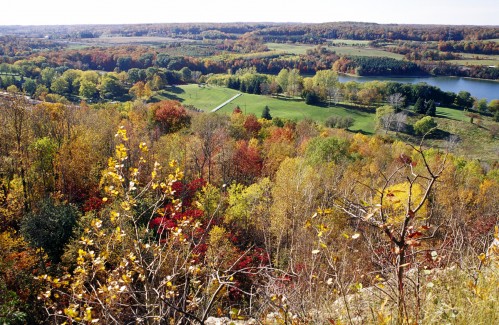 nto – In a precedent-setting decision, the Niagara Escarpment Commission voted to process Protecting Escarpment Rural Land’s (PERL) private amendment application for the Nelson Aggregate Co. proposed quarry site that, if approved, would see a significant part of the Mount Nemo Plateau, on the Niagara Escarpment in Burlington, Ontario, permanently protected.
Burlington Mayor and Halton Regional Councillor, Cam Jackson, presented two unanimous Council resolutions supporting PERL’s application as a “first step” to protecting the entire Mount Nemo Plateau.
Commissioner Alan Elgar tabled the motion and affirmed, “It is our job to implement the NEPDA [Niagara Escarpment Planning and Development Act], and its purpose is to ‘maintain the Niagara Escarpment substantially as a continuous natural environment’.” After the vote, Elgar announced, “This is a precedent-setting decision and it is the right one. It says: the NEC will process applications in accordance with the Act that are in keeping with its purposes.”
“We could not be more impressed with the Commission,” stated Roger Goulet, Executive Director of PERL. “We must get the land-use designations right before decisions are made on development applications. This is what we have been saying for years.”
Many environmentally sensitive areas within the Niagara Escarpment Plan area would be protected by today’s standards and science but are left vulnerable to development by the 25-year-old Niagara Escarpment Plan designations.
“Right now the process is upside-down,” commented Lia Magi, a lawyer with Donnelly Law representing PERL. “Bringing a third-party application was the only way to put the proper land-use designation, based on the most current science, squarely in front of a decision-maker while it is still relevant,”Magi added.
About Environmental Defence (www.environmentaldefence.ca): Environmental Defence protects the environment and human health. We research solutions. We educate. We go to court when we have to. All in order to ensure clean air, clean water and thriving ecosystems nationwide, and to bring a halt to Canada's contribution to climate change.
-30-
For more information, or to arrange interviews, please contact: Lia Magi, Donnelly Law, 647-654-2049, lia@donnellylaw.ca Roger Goulet, Executive Director, PERL, 905-335-4219, rgoulet@cogeco.ca
Activists win historic ruling on 'people's law on the environment'
Crippling costs of legal action prevents people mounting challenges over environmental damage, finds UN Committee
Ecologist / 26th August, 2010
 Activists were celebrating a damning ruling today on the UK's legal system which could now make it easier for individuals and NGOs to protect the environment.
Under the Aarhus Convention, signed by the UK in 1998, people should not be denied environmental justice because of the unreasonable financial risks of bringing a case to court.
A team of legal activists had brought the case to the UN committee overseeing this Convention arguing that the UK was in breach and that bad environmental decisions were not being challenged. Prevented from justice
Recently, the Marine Conservation Society was unable to mount a legal challenge against allegations of toxic waste dumping near the Port of Tyne, Newcastle, because of fears over the potentially crippling costs of losing the case.
In another example cited by the legal activists, a local resident was faced with a legal bill of more than £80,000 after challenging permission given to a cement factory to burn tyres because of health fears over the fumes on the local community.
The Aarhus Convention Compliance Committee agreed and said the UK's legal system did not, 'remove or reduce financial barriers to access to justice'. It called on the UK to 'undertake practical and legislative measures to overcome the problems'.
A victory for green groups A coalition of environmental groups, including Friends of the Earth, WWF and RSPB, who have been campaigning on the issue welcomed the decision and said the UK now had 'no option but to amend the cost rules so people and environmental groups can go to court to protect the environment.'
The legal activists who brought the case to the UN, ClientEarth, said the decision was 'game-changing' for anyone fighting for their environmental rights.
'At the moment, the government and industries can ride roughshod over their environmental responsibilities, confident that the legal system’s failings will make challenges impossible.
'If the government’s word is to mean anything on the international stage, it must move effectively and decisively to remedy the gross unfairness of the UK legal system,' said CEO ClientEarth James Thornton. UK given warning
The UK has already been warned by the EU Commission about the unfair cost of challenging decisions that impact on the environment. In March, 2010, EU Environment Commissioner Janez Potocnik threatened legal action if the UK ignored the request.
A review by Lord Justice Jackson earlier this year may go someway, if accepted, to meeting that request. It recommended that people bringing civil cases should not normally be at risk of having to pay the other side's costs. However, it did not indicate whether people would be aware of their liability for costs beforehand.
In reference to that review, a spokesperson for the Ministry of Justice admitted that high costs under the existing legal system had become a 'serious concern' and that a consultation would be launched this Autumn to 'achieve significant costs savings, whilst still enabling those who need access to justice to obtain it'. In relation to the Aarhus ruling, a government spokesperson said it was, 'carefully considering the Committee’s recently published draft findings along with our comments for submission to the Committee in order to assist the Committee finalise its findings.' Useful links The Aarhus Convention
**
Top of the Niagara Escarpment under Siege
National environmental group supports call for a time-out on massive hearings in Ontario's Greenbelt
Toronto – Environmental Defence is joining forces with the Niagara Escarpment Commission, Clearview Community Coalition and Protecting Escarpment Rural Land (PERL) to protect the Niagara Escarpment, which is under threat from two proposed quarries. One quarry, proposed by Walker Aggregates Inc., was already proposed for Duntroon, Ontario near Collingwood, when plans for yet another quarry only 600 metres away, was announced by M.A.Q. Aggregates last week.
“Clearly, there is no coordination or assessment of the cumulative effects of these two proposed quarries. The Duntroon Quarry license application itself is a serious test case for protecting the Niagara Escarpment, the Greenbelt and Ontario’s freshwater resources,” said Dr. Rick Smith, Executive Director of Environmental Defence. "Taken together, these two proposed quarries could cause significant environmental damage."
The more imminent of the two new quarries proposed near the tiny hamlet of Duntroon is scheduled for a joint Ontario Municipal Board (OMB) and Environmental Review Tribunal (ERT) hearing starting on April 12, 2010. Without consulting residents, however, a settlement has been negotiated between Walker Aggregates Inc., Simcoe County and Clearview Township which, in part, transfers a portion of County Road 91 from Simcoe County to Clearview Township for future closure. This agreement was apparently approved ‘in camera’ by Clearview Township on February 10, 2010, then discussed again ‘in camera’ and approved by Simcoe County Council on February 25, 2010. As a result, Simcoe County and Clearview Township are now in favour of Walker Aggregates’ quarry proposal.
The site of the Walker Aggregates’ application is located just steps away from the highest point of the Niagara Escarpment, which is an amazing complex from an environmental perspective. The new quarry would result in the permanent removal of 40.5 ha of significant woodland, which contain precious interior forest and provides for contiguous animal habitat. Protection of endangered butternut trees and a world-class colony of American Hart’s Tongue Fern would be left to a strategy called isolation, and experts are sceptical that this strategy would work. The colony of Hart’s Tongue Fern under threat is greater in number than the sum of all colonies outside of Canada.
Walker Industries has already been quarrying the Duntroon Escarpment since 1968 and is now proposing to quarry for another 14 to 29 years and to more than double the current annual rate of extraction to 2.5 million tonnes.
“The agreements between Walker Aggregates Inc. and the municipalities of Clearview and Simcoe have done little to reduce community impacts and nothing to reduce the impacts on the Niagara Escarpment,” said Janet Gillham, President of the Clearview Community Coalition and a local resident who is outraged by the negative impacts to local communities and by the prospect of continued destruction of the Niagara Escarpment, a valued local natural heritage feature and a World Biosphere Reserve.
“The Walker quarry proposal and Niagara Escarpment Plan re-designation application has been revised more times than we can count, yet the current designation on the site hasn’t been updated since the Trudeau years,” said David Donnelly, legal counsel to Environmental Defence and Clearview Community Coalition.
The newly announced 30-million-tonne M.A.Q. Aggregates quarry proposed in Grey County, which was appealed to the Ontario Municipal Board last week, would be directly across the road from the Walker Aggregates quarry. The site is in the center of the Rob Roy Provincially Significant Wetland complex. Species potentially impacted include the special-concern Canada Warbler and the Western Chorus Frog. Despite close proximity of these two proposed quarries, it is not clear whether the cumulative effects of the two quarries have been adequately evaluated.
Clearview Community Coalition is a member of the Ontario Greenbelt Alliance, a coalition of more than 80 environmental, health and community groups dedicated to protecting Ontario’s Golden Horseshoe Greenbelt.
About Environmental Defence: Environmental Defence protects the environment and human health. We research. We educate. We go to court when we have to, all in order to ensure clean air, safe food and thriving ecosystems. Nationwide. http://www.environmentaldefence.ca/
For more information, or to arrange interviews, please contact: Jennifer Foulds, Environmental Defence, (416) 323-9521 ext. 232; (647) 280-9521 (cell) Janet Gillham, President, Clearview Community Coalition, (705) 445-6095
Earthroots and Timmins Residents Join in Eastern Cougar Fight
Ministry of Natural Resources and AbitibiBowater Clear-cut Endangered Species Habitat
Toronto—Ms. Patricia Del Guidice, a long-time resident of Timmins, Ontario and the environmental group Earthroots, filed an Application for Investigation under section 74 of Ontario’s Environmental Bill of Rights to save the Eastern Cougar, an endangered species in Ontario. With permission from the Ministry of Natural Resources (“MNR”), AbitibiBowater clear-cut in Block 60 of the Nighthawk Forest, despite multiple reported Eastern Cougar sightings and an admission by the MNR that it had little idea if denning sites would be affected by the cut.
“This is not a case where the MNR and the logging company have done a poor job of complying with the Ontario Endangered Species Act, this is a case of ignoring the Act altogether,” said Amber Ellis, executive director of Earthroots.
“The MNR and Abitibi should finally admit what it seems everyone else in Timmins knows – there are Cougars in the Nighthawk Forest and around Timmins itself that need consideration and protection,” Ellis added.
Endangered species habitat is protected from damage or destruction under the Endangered Species Act, 2007 (“ESA”) and Eastern Cougars have been listed as an endangered species under provincial legislation for years. Habitat loss and human disturbance are cited as primary threats to the species’ recovery.
According to the Environmental Commissioner of Ontario (“ECO”), the number of Cougar sightings in Ontario has been steadily increasing, with approximately 500 reported sightings since 2002. There have been several sightings of the Eastern Cougar in the Nighthawk Forest reported to the MNR and the Nighthawk Forest has been identified as Eastern Cougar habitat. Yet, the MNR continues to formally reject claims that Cougars reside there.
In the Timmins area, recent sightings have been made from short distances by long-time Northern Ontario residents – witnesses who know the difference between a coyote and a cougar, as they would a dog from a cat – however, the MNR has been consistently ‘unable to verify reported sightings’. Consequently, forestry companies have not been implementing adequate habitat protection measures, if any, which is contributing to the lack of Eastern Cougar recovery in Ontario.
“The MNR attempted to verify reported Cougar sightings by placing cameras in the Nighthawk Forest during hunting season, when the area was full of activity. There were all-terrain vehicles, cars and trucks traveling throughout the area. There was also an abundance of gunshots. The likelihood of a sighting under these conditions is remote at best. We can only conclude that the MNR had no genuine interest in verifying the sightings,” said Patricia Del Guidice.
The forestry sector was required to comply with the ESA by June 30th, 2009; however, the MNR did not require Abitibi to amend its Forest Management Plan to provide for Eastern Cougar habitat identification and protection measures. In fact, the MNR granted Abitibi permission to clear-cut portions of the Nighthawk Forest as late as November 2009, despite Earthroots’ and Ms. Del Guidice’s efforts to advise them of their ongoing non-compliance with the ESA with respect to the Eastern Cougar.
After several failed attempts to secure a moratorium on logging to allow for proper Eastern Cougar monitoring, Ms. Del Guidice and Earthroots submitted an Application for Investigation to the ECO, alleging that the harvesting in the Nighthawk Forest has destroyed Eastern Cougar habitat and that the Forest Management Plan does not provide for Eastern Cougar habitat identification or protection – both clear contraventions of the ESA.
In the Nighthawk Forest and Timmins area, a cursory investigation by Donnelly Law turned up multiple sightings in 2008 and 2009 alone, none of which had been adequately verified by the MNR.
“If our clients are dissatisfied with the section 74 Investigation, they can challenge the license going forward or prosecute Abitibi for violating the Act,” said David Donnelly, counsel to the Applicants.
“It really boggles the mind that the Ontario government would further diminish its already fragile reputation for poor forest management practices by ignoring an important piece of legislation like the ESA,” Donnelly added.
For more information contact:
D. Donnelly, Donnelly Law A. Ellis, Earthroots P. Del Guidice, Applicant
Gravel Road Relocation Raises Troubling Questions
Gravel Road Relocation Raises Troubling Questions: Canadian Music Icon Seeks Protection of Fallsbrook Creek & Sawguin Creek Marsh
Canadian Music Icon Seeks Protection of Fallsbrook Creek & Sawguin Creek Marsh
Ameliasburgh—Area residents are challenging the relocation of a gravel access road on Gore Road near County Road 23 in Ameliasburgh, Prince Edward County. W. D. Harris Excavating Ltd. (“Harris”) applied to the County and the Ministry of Natural Resources for permission to relocate the road earlier this year and received approval by September 2009 without providing notice to affected residents.
The residents, led by Canadian music icon Bernie Finkelstein, the founder of True North Records and long-time manager of Bruce Cockburn, are concerned that the relocation of the road may adversely impact on Fallsbrook Creek, a significant flood plain that traverses the Harris property and drains into the Sawguin Creek Marsh.
“The Sawguin Creek Marsh, part of which sits on the southern edge of our property, stretches well beyond our borders and into the centre of the County. It’s considered one of the most significant wetlands in the province,” said Mr. Finkelstein, citing the Natural Heritage League who became interested in protecting the wetland complex in 1992.
“Although a portion of the marsh sits within our property line, I know that no one can ever truly own a wetland; it’s a shared natural resource. We do, however, take our responsibility as stewards of this significant natural feature seriously and we find it hard to believe that we were cut out of this process.”
The proposed relocation of this commercial road will be nearly 1,400 feet closer to Fallsbrook Creek. The environmental impacts of the road’s construction and use by gravel trucks on the Creek and Marsh are unclear, but neither the County nor the Ministry required Harris to assess these potential impacts prior to granting the approvals. In fact, the County accepted a sketch by Harris on its entrance permit application which labelled Fallsbrook Creek as a “drainage ditch”.
The quarry, operating in the area for decades, has a long and interesting history. In the 1980’s, residents successfully opposed a significant quarry expansion. In 1996, a proposal to relocate the access road next to Fallsbrook Creek was rejected. In both cases, the residents were notified by the County well in advance of any approvals being issued.
Strangely, the County appears to have revised its policy as it did not provide notice to residents about this proposed road relocation.
Elizabeth Gerrits, owner of the adjoining land, remembers previous battles. “In the past, the local community was always allowed to present its perspective on the impacts of proposed changes to the quarry, and decision-makers chose to keep the quarry and the road where they were. It is unclear why these well-considered decisions have been summarily overturned by sneaking this through without anyone in the community having a fair opportunity to speak on the issue,” said Gerrits.
“It’s bizarre. I now realize that the whole process occurred out of sight and without notice to any of us. I’m stunned,” said Mr. Finkelstein. Ms. Gerrits finds it unthinkable that the landscape is about to change. “For over two hundred years, the Redner family farm has been bordered by woods, streams and wetlands, not by a commercial road for gravel trucks.”
In general, an affected party’s procedural fairness rights include both a right to receive notice and the opportunity to state his/her case (see Baker v. Canada (Minister of Citizenship and Immigration), [1999] 2 S.C.R. 817). In this case, relocation of the Harris access road and road entrance means an increase in aggregate truck traffic near residents and the watercourses, which means increased dust, noise and vibration. These nuisances may adversely impact on the quiet enjoyment of the residents’ property, but they may equally compromise the integrity, features and functions of the Fallsbrook Creek, flood plain and Sawguin Creek Marsh. Given the importance of this decision to the residents, they were entitled to be notified and to make submissions to the County and the Ministry.
In granting the entrance permit, the County did not alert area residents. In granting an amendment to the quarry’s site plan, the Ministry decided to merely post an instrument on the EBR Registry for a 30-day commenting period. Since area residents did not receive notice of this application, they were unaware of the posting and therefore unable to submit comments in time. Merely posting an instrument proposal on the EBR website without notifying affected parties does not meet the standard of notice and participation rights to which the residents are entitled.
Mr. Finkelstein and others have now retained lawyer David Donnelly, NOW Magazine’s “Best Green Activist” for 2008 and recipient of Earth Day Canada’s “Hometown Hero” Award. “The Environmental Commissioner of Ontario has commented several times that the Aggregate Resources Act is out of date – this is one of the worst examples that I have seen of excluding the public,” said Donnelly.
“We expect Prince Edward County to join Mr. Finkelstein and residents in closing this loophole and stopping the road,” Donnelly added.
Mr. Finkelstein and neighbours have now joined the fight to reform the Aggregate Resources Act, including stronger public notice provisions. The group would also like to grow the greenbelt in Prince Edward County and are determined to see a Green Gravel Standard for Ontario. Prince Edward County has been discovered by developers and needs protection like the Niagara Escarpment, Holland Marsh and the Duffins Rouge Agricultural Preserve.
Residents anticipate an Ontario Municipal Board hearing on this issue in spring of 2010.
For more information: Bernie Finkelstein, 416-402-9937, bernie@finkelsteinmanagement.com David Donnelly, 416-722-0220, david@donnellylaw.ca